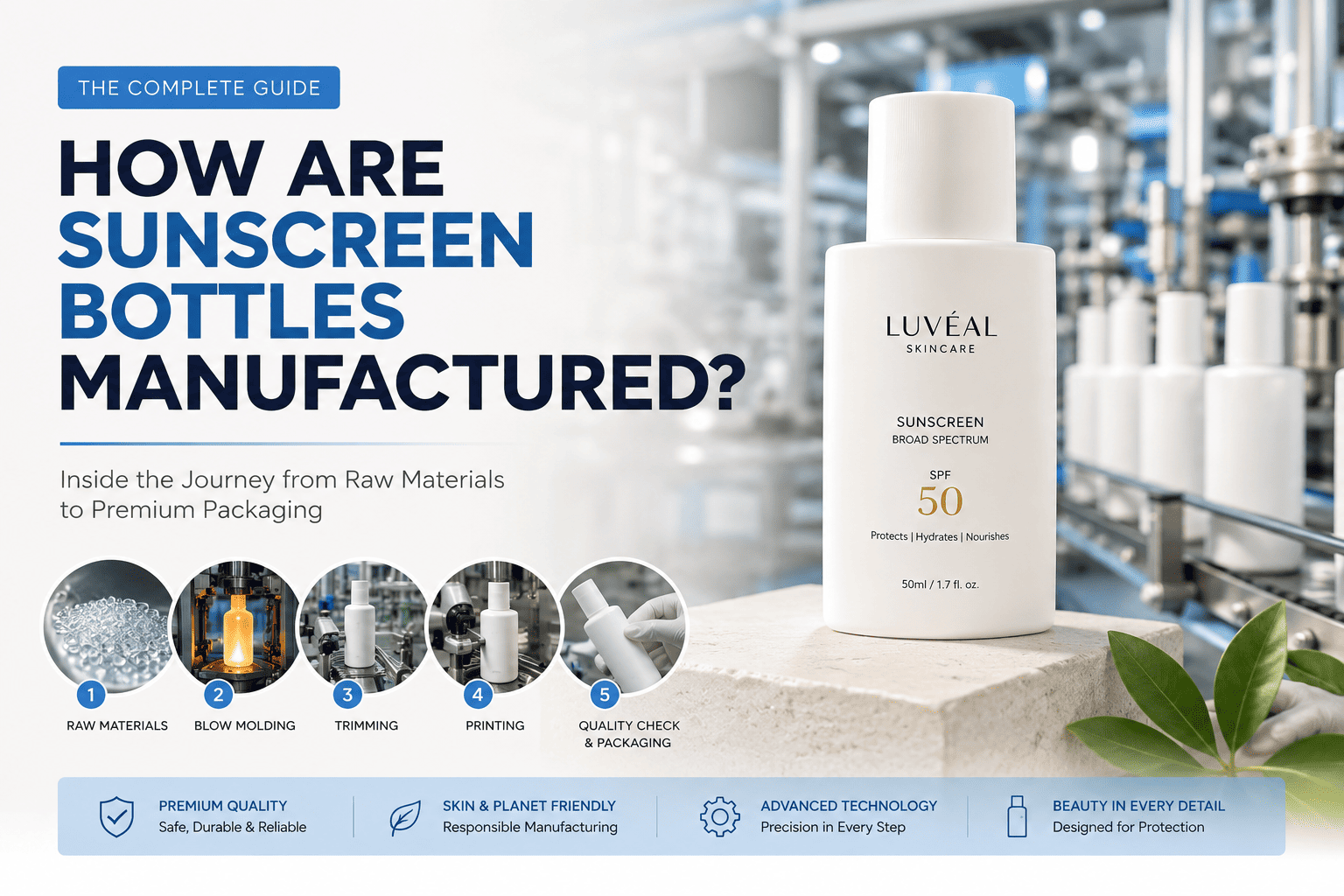
You pick up a sunscreen bottle and it feels solid, seamless, and perfect. You wonder how it's made. It seems like a complex process that turns raw plastic into a product you trust to protect your skin.
Sunscreen bottles are made in a two-stage process. First, plastic resin is heated and shaped into a bottle using blow molding or injection molding. Second, the finished bottle is decorated with printing, hot stamping, or other surface treatments.
Sunscreen bottle manufacturing process from plastic molding to finished cosmetic packaging
Your insight is exactly right and gets to the core of what we do every day at my factory. The entire process is built on that simple, two-step logic: shape first, decorate second. I remember explaining this to a new client who was worried about their custom design. They thought the printing happened on a flat sheet of plastic that was then folded into a bottle. I walked them through our process using a video call. I showed them the blow molding machine creating hundreds of perfect, plain white bottles. Then, I showed them those same bottles moving to our automated silk printing line where their beautiful design was applied. They had a "lightbulb" moment. Separating these two stages is the key to quality control and allows for almost unlimited creative customization on a solid, perfectly formed foundation.
How Is Sunscreen Itself Manufactured?
You know how the bottle is made, but what about the lotion inside? You're curious about how the active ingredients and other liquids are actually mixed together to create the final sunscreen formula.
Sunscreen formula is made in phases. Oil-based ingredients and UV filters are mixed in one tank, while water-based ingredients are mixed in another. Then, the two are slowly combined (emulsified) to create a stable lotion.
Sunscreen manufacturing process showing oil phase, water phase and emulsification
While my expertise is in creating the perfect home for the formula, I work so closely with brands that I've learned a lot about how the magic inside the bottle is made. The process is a lot like high-tech cooking. There is an "oil phase" where all the oil-soluble ingredients, like the chemical UV filters and emollients, are heated and mixed together. At the same time, in a separate, massive stainless-steel tank, there is a "water phase" where all the water-soluble ingredients are combined. The real magic is the emulsification step. The oil phase is slowly added to the water phase while a high-shear mixer spins incredibly fast, almost like a giant immersion blender. This breaks the oil down into tiny droplets that get suspended perfectly in the water, creating the smooth, white lotion we all recognize as sunscreen. It's a precise chemical process that creates a product that feels good on the skin and keeps the UV filters evenly distributed.
What Are Sunscreen Bottles Made Of?
You see all kinds of sunscreen bottles on the shelf—some are soft and squeezable, others are hard and feel luxurious. You want to know what plastics are used and why a brand would choose one over another.
Sunscreen bottles are typically made from PE (Polyethylene) for soft tubes, PET (Polyethylene Terephthalate) for rigid, clear bottles, or PP (Polypropylene) for caps and airless pump components due to its strength.
PE, PET and PP plastics used in sunscreen bottle manufacturing
Choosing the right material is one of the most important decisions a brand makes, and it's a conversation I have with every client, from Shubihika at RAS Beauty to Sani at PT. PASCAL. The material choice affects the product's feel, function, and compatibility with the formula. Each plastic has its own personality and job to do.
The 3 Main Plastics in Sunscreen Packaging
| Plastic | Common Name | Key Characteristics & Use Case |
|---|---|---|
| PE | Polyethylene | Soft & Flexible. This is the workhorse for classic squeeze tubes. It's durable and cost-effective. Perfect for body and family sunscreens. |
| PET | Polyethylene Terephthalate | Rigid & Clear. This gives a premium, glass-like look. It's great for facial sunscreens and pump bottles. It's also highly recyclable. |
| PP | Polypropylene | Strong & Stiff. It has high heat resistance and chemical resistance. We use it for caps, closures, and the inner workings of pumps. |
Sometimes we even use PETG, a cousin of PET, which offers even better clarity and toughness. The choice always comes down to the brand's goals. Does Shubihika want a premium feel for her luxury line? We choose PET. Does Sani need a durable, eco-friendly option? We recommend PE with post-consumer recycled content.
What Is the 3-1-1 Rule for Sunscreen?
You're getting ready for a flight and packing your bag. You grab your favorite sunscreen but then hesitate, worried it might be taken away by airport security. You need to know the rule.
The 3-1-1 rule is a TSA guideline for carry-on liquids. It means liquids must be in containers of 3.4 ounces (100ml) or less, all fitting inside one clear, 1-quart-sized zip-top bag.
30ml, 50ml and 100ml sunscreen bottles designed for travel and TSA compliance
This rule has a huge impact on the packaging industry. It's not just a travel tip; it's a major factor in product development and sales. Many people buy sunscreen specifically for a vacation, so if your product doesn't meet this requirement, you lose that entire market. That's why the 100ml size is so critical. However, the most popular and strategic size for facial sunscreen is actually 50ml (1.7 oz). Why? Because it comfortably fits inside the one-quart bag along with other toiletries, making it the perfect travel companion. At my company, we have invested in dozens of molds specifically for bottles and tubes in sizes of 100ml, 75ml, 50ml, and 30ml. We help brands create "travel-friendly" or "TSA-approved" versions of their bestsellers. By producing these compliant sizes, we help our clients turn a government regulation into a powerful marketing opportunity and a driver for new sales.
Conclusion
Sunscreen bottles are made in a simple but precise two-step process: molding the shape, then decorating the surface. This method ensures a quality container that perfectly represents the brand's identity.
Written by

Mike Lee
You may also be interested in:
What Makes a High-Quality Sunscreen Bottle?
You've spent months perfecting your sunscreen formula, but you know that the bottle is the
What Should You Know Before Starting OEM Sunscreen Packaging?
You have a vision for your brand and a killer sunscreen formula ready to go.
How Can You Import Sunscreen Bottles from China Safely?
You've found the perfect packaging and the price is great, but the idea of importing

How Do You Choose the Best Sunscreen Lotion Bottle for Your Brand?
Your perfect sunscreen formula is wasted in a leaky bottle. Customer complaints are piling up,