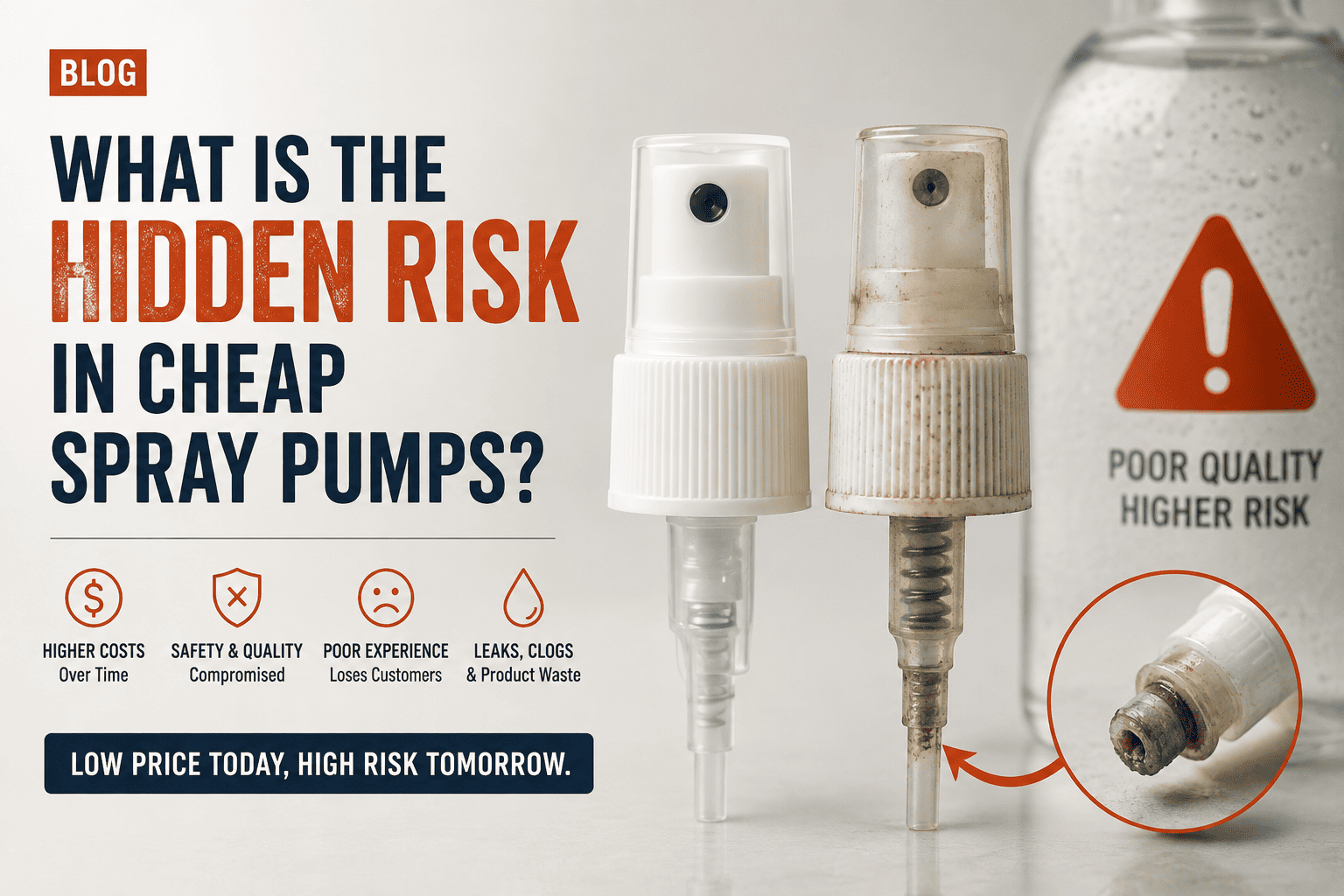
You're trying to cut costs, and you've found a spray pump that's a few cents cheaper. It seems like a smart saving, but you're unknowingly trading a tiny upfront cost for a massive risk of product returns, bad reviews, and long-term brand damage.
The hidden risk is functional failure. Cheap pumps are not built for stability or durability. They clog, leak, and break after a few weeks of use, creating a frustrating user experience that destroys customer trust and leads to costly negative feedback.
A dramatic split image: on the left, a frustrated customer holding a sputtering, broken spray pump. On the right, a spreadsheet showing a brand's profit margin being erased by the high cost of returns and replacements.
Your insight is something I have seen proven time and time again. I remember a brand that launched a fantastic new body mist. They sourced a very inexpensive pump to maximize their profit margin. The first month, everything was great. The second month, their customer service was flooded with emails. The springs inside the pumps were low-grade steel, and they were rusting from contact with the fragrance, causing the pumps to seize up. They had to recall the entire batch. The cost of the recall, the lost inventory, and the damage to their reputation was a hundred times more than the "savings" from the cheap pumps. It's a hard lesson: for a spray bottle, the pump is not an accessory; it is the core of the product.
What Does a Cheap Pump Sprayer Actually Cost You?
You see a quote for a pump that is $0.05 cheaper than another. Multiplied by 50,000 units, that's a $2,500 saving. It feels like a no-brainer. But you're only looking at the initial cost, not the total cost of failure.
A cheap pump costs you customer loyalty, future sales, and the expense of managing returns. The real cost is not the price of the pump but the price of a single one-star review that lives online forever.
An image of a smartphone displaying a one-star review: "Loved the scent, but the pump broke after a week. Won't buy again."
Let's do the real math. That $2,500 you "saved" upfront can be wiped out instantly. Imagine just a 5% failure rate in your first batch of 50,000 units. That's 2,500 unhappy customers. Let's say half of them contact your customer service team. That's hours of your staff's time spent responding to angry emails. Let's say you offer to replace those 2,500 units. You've now paid for the product and shipping twice for those customers. But the biggest cost is the one you can't measure. It's the silent customers who don't complain; they just never, ever buy from you again. And they tell their friends about their bad experience. The cost of a cheap pump isn't a line item on an invoice; it's a slow, silent erosion of your brand's future. For a brand like Shubihika's at RAS BEAUTY, which is built on a premium promise, this kind of failure is simply not an option.
The True Cost Calculation
| Initial "Saving" | The Hidden Costs |
|---|---|
| -$2,500 | + $5,000 in replacement product cost. + $1,000 in customer service labor. + ? in lost future sales from bad reviews. |
How Can You Look for a Great Spray Pump?
You understand the risk of a cheap pump. Now you need a practical checklist. When you're evaluating a supplier's options, what specific features should you look for to identify a high-quality, reliable pump?
Look for three key indicators of quality: the material of the internal spring (it must be SUS 304 stainless steel), a high-precision pump engine that prevents leaks, and a supplier who can provide life-cycle test data.
An image of a disassembled pump, with callouts pointing to the shiny, rust-free stainless steel spring and the perfectly molded plastic piston.
A great pump isn't just about how it looks on the outside. The magic is in the engine inside. When I'm evaluating a pump for a client, I look for these non-negotiable features.
- The Spring Material: This is the heart of the pump. A cheap spring will rust or lose its tension. Insist on a spring made from SUS 304 Stainless Steel. It is corrosion-resistant and engineered to provide a consistent, smooth return action for tens of thousands of pumps.
- The Piston and Gasket: The seal must be perfect. Look for a pump with a precisely molded piston and a gasket made from a chemically resistant material. This prevents leaking and ensures a consistent vacuum with every stroke.
- Life-Cycle Testing: Don't just take the supplier's word for it. Ask them: "Have you tested this pump? Can you show me the data?" A serious manufacturer like Rland performs automated life-cycle testing, where a machine pumps the sprayer thousands of times to ensure it doesn't fail. We can show you that data.
What's the Best Choice for a Spray Head?
You're launching a new product, and the "feel" of the spray is critical. Should it be a delicate cloud for a facial mist or a more direct spray for a hair product? How do you make the right choice?
The best choice depends entirely on your formula and its intended application. Choose a "fine mist" sprayer with a low output (0.12ml) for facial products and a "standard" sprayer with a higher output (0.18ml+) for body or hair.
A split image: on the left, a woman enjoying the delicate cloud from a fine mist sprayer on her face. On the right, a person applying a more direct spray to their hair.
This is the final piece of the quality puzzle. It's not just about durability; it's about performance. A "one-size-fits-all" approach to spray heads is a recipe for a bad user experience. You must match the pump's mechanics to the product's mission. For a product going on the face, like a toner or setting spray, the goal is a soft, weightless, enveloping mist. This requires a fine mist sprayer. These have special nozzles designed to atomize the liquid into micro-droplets. For a product going on the body or hair, you often need more product and more direct coverage. A standard sprayer is more efficient here. It delivers a wetter, more substantial spray that can cover a larger area quickly. For a detail-oriented brand manager like Sani, who needs to launch a variety of products, having a supplier that can provide a range of high-quality pump options is essential.
Conclusion
The small savings from a cheap spray pump are an illusion. Investing in a high-quality pump with a stainless steel spring and proven durability is the only way to protect your product, your reputation, and your customers' trust.
Written by

Mike Lee
You may also be interested in:

How Do You Choose the Right Sunscreen Bottle Packaging for Your Brand?
You have a fantastic sunscreen formula ready to go, but now you face a sea

Sunscreen Packaging for Hot Climates: What Do Brands Need to Know?
Your brand is targeting a tropical market, but you're worried. The intense heat and humidity

How Does a Packaging Idea Become a Real Product?
You have a brilliant idea for a cosmetic product, but the path from a sketch

What Will Be the Most Popular Sunscreen Bottle Sizes in 2026?
You're planning your product line for the next two years, but you're stuck on a