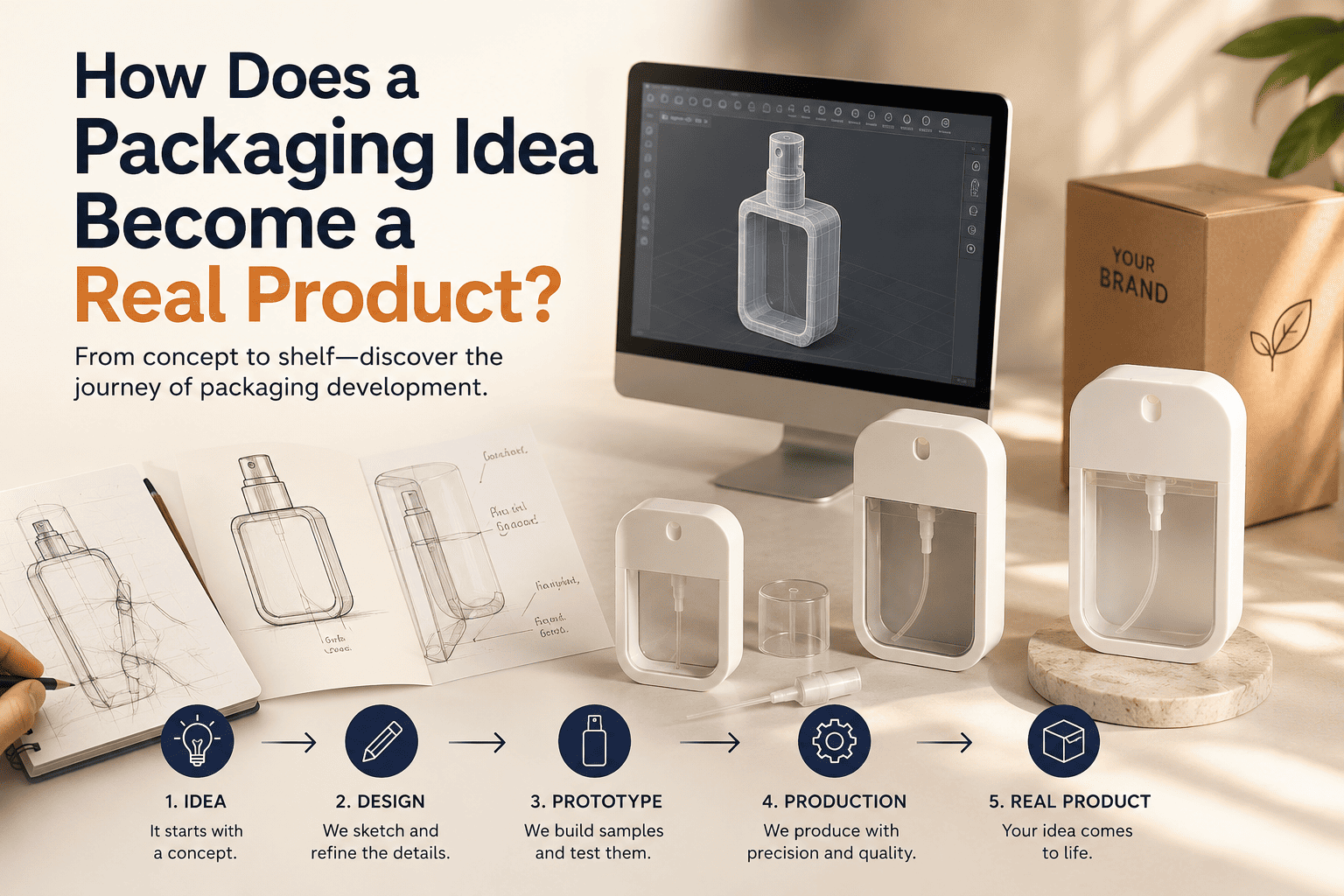
You have a brilliant idea for a cosmetic product, but the path from a sketch on a napkin to a physical bottle in your hand seems impossibly complex. You're afraid of missing a crucial step or making a costly mistake along the way.
The journey from concept to production follows a structured path. It begins with market research and concept strategy, moves to design and prototyping, then proceeds to mold fabrication, and finishes with mass production like injection molding and printing.
A flowchart-style image illustrating the key stages: Research -> Design -> Prototype -> Mold -> Production -> Finishing.
Your insight perfectly describes the roadmap we build for every single one of our clients. This isn't just a list of services; it's a story that unfolds over weeks and months. I remember working with Shubihika from RAS BEAUTY. She came to us with an amazing new serum formula but a very vague idea for the packaging. She just said, "I want it to feel premium." Instead of jumping to show her bottle samples, we started at the very beginning: the concept. We asked questions: Who is the customer? What does "premium" mean in the Indian market? By starting with the "why" before the "what," we co-developed a concept that led to a beautiful, faceted PET bottle that perfectly matched her brand's story. That bottle became one of her bestsellers.
What Is the Core Concept of Packaging?
Before you even think about shapes or colors, you feel like there's a bigger question. What is the fundamental job of the packaging? What core idea should guide all your future decisions?
The concept of packaging is its core purpose. It's not just a container; it's a silent salesman that must protect the product, attract the customer, communicate the brand's story, and provide a functional user experience.
An image showing a customer in a store picking a product off the shelf, attracted by its packaging design.
The "concept" is the strategic foundation. I always tell my clients that if we get the concept right, all the other decisions become much easier. It’s the first and most important phase, driven by market research just as you said. For example, when Sani from PT. PASCAL needed a package for their new plant-based detergent samples, their core concept was "eco-friendly innovation." This single idea drove everything. It meant we had to use materials with high recycled content (PCR plastic). It meant the design had to look clean and natural. It meant the bottle had to be small and efficient to reduce waste. The concept isn't about aesthetics; it's about the job the package needs to do. It defines the problem that the design and production process will later solve. It’s the "North Star" for the entire project.
What Is the Packaging Development Process?
You understand the concept, but now you need the practical steps. What is the exact, step-by-step roadmap from that initial idea to having thousands of finished units ready to ship?
The development process is a four-stage journey: 1) Strategy and Design, 2) Engineering and Prototyping, 3) Tooling and Pre-Production, and 4) Mass Production and Finishing. Each stage builds upon the last.
An image of an engineer's desk with a computer showing a 3D CAD model, a 3D-printed prototype, and a finished product next to it.
This process is the engine of our factory. We have refined it over years to be as efficient and predictable as possible, turning a client's vision into a physical reality. Here’s a breakdown of the journey we take with our clients:
The 4 Stages of Packaging Development
| Stage | Key Activities | My Factory's Role |
|---|---|---|
| 1. Strategy & Design | Market research, concept definition, 2D sketches, brand identity alignment. | We collaborate with the client, asking the right questions to define the core concept and create initial design mockups. |
| 2. Engineering & Prototyping | Creating 3D CAD models, material selection, functional analysis, and creating physical samples. | Our engineers turn the 2D design into a manufacturable 3D model. We use our 3D printers for rapid prototyping in 72 hours. |
| 3. Tooling & Pre-Production | Designing and fabricating the high-precision steel molds for injection or blow molding. Running first samples. | This is our core expertise. We create the production mold and run a small batch of "first-off-tool" samples for final approval. |
| 4. Mass Production & Finishing | Running the molding machines for the full order quantity. Applying decorations like printing and hot stamping. | Our 20+ molding machines run 24/7. The bottles then move to our automated lines for silk printing, UV coating, etc. |
By following this structured process, we eliminate surprises and ensure the final product is exactly what the client dreamed of.
What Are the Four C's of Packaging Design?
You're in the design stage, and you need a framework to guide your creative choices. How can you ensure your design is not only beautiful but also commercially effective?
The four C's of packaging are: Contain, Communicate, Convenience, and Connect. A successful design must master all four to protect the product, inform the buyer, be easy to use, and build a brand relationship.
A graphic with four quadrants, each labeled with one of the "C's" (Contain, Communicate, Convenience, Connect) and a simple icon.
This is a classic marketing framework that I use as a mental checklist during the design phase. It helps us ensure the packaging is working as hard as possible for the brand.
-
Contain: This is the most basic job. The package must hold the product without leaking, breaking, or reacting with the formula. It’s about structural integrity and material compatibility—the technical foundation.
-
Communicate: The package has seconds to grab attention on a shelf and tell a story. What is this product? Who is it for? Why should I trust it? This is achieved through color, shape, typography, and high-quality printing.
-
Convenience: How easy is it to open, hold, dispense, and store? A pump that clogs or a cap that's hard to open creates a negative experience that customers remember. We focus on ergonomics and functional design to ensure total convenience.
-
Connect: This is the highest level. Does the packaging create an emotional connection? Does its look, feel, or sustainable story make the customer feel good about their purchase? This is what turns a one-time buyer into a loyal fan. When we design, we are thinking about all four C's at once.
Conclusion
The journey from concept to reality is a structured process. It starts with a strong concept and moves through design, prototyping, and tooling, ending in a physical product that sells.
Written by

Mike Lee
You may also be interested in:
What Will Be the Most Popular Sunscreen Bottle Sizes in 2026?
You're planning your product line for the next two years, but you're stuck on a
What are the Top 10 Sunscreen Packaging Mistakes Brands Make?
You've perfected your sunscreen formula. Now comes the stressful part: packaging. You're worried that a
What Makes a Good Sunscreen Packaging Design?
You've spent a fortune on a great formula, but now you need a package. You're
What Packaging Works Best for SPF Products?
You've perfected your SPF formula, a major investment. Now you face a critical choice: the